Concrete Driveway Sealing Cary, NC: Homeowner's Guide

Updated: Aug 18
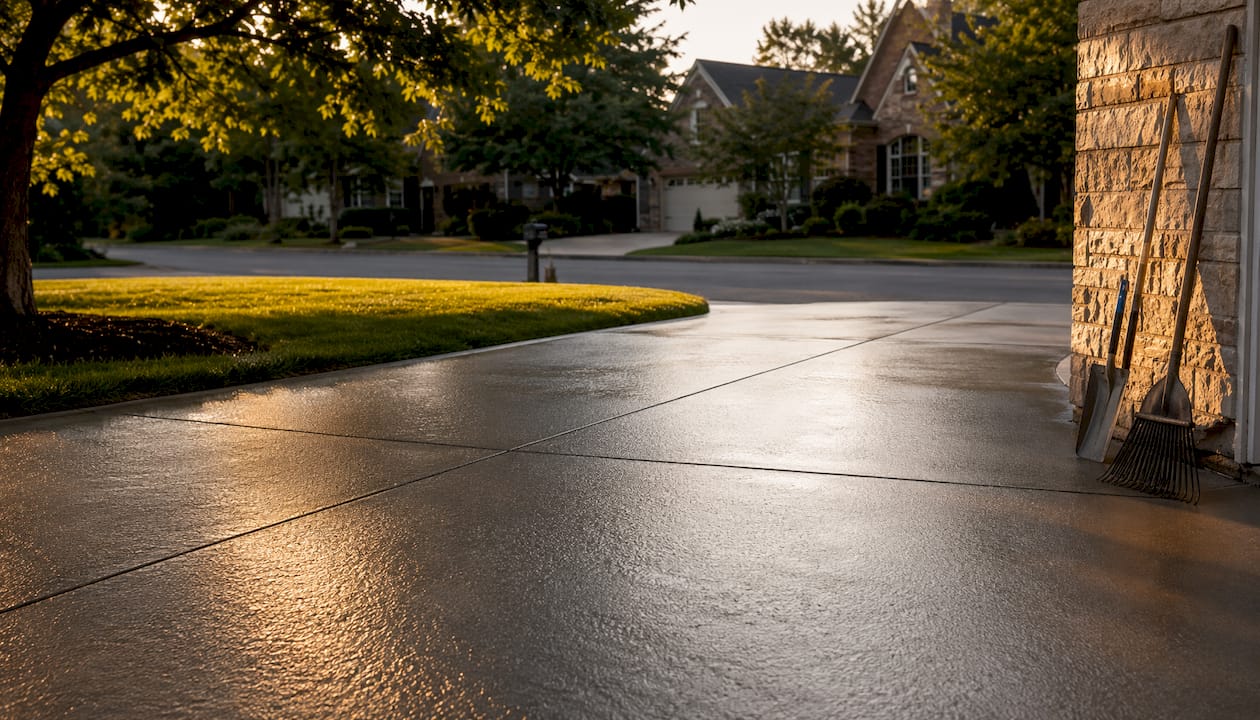
Professional concrete driveway sealing protects your slab from moisture, freeze-thaw damage, oil stains, and surface wear. For Cary and Wake County homeowners, the right call is a penetrating silane/siloxane sealer for long-term durability, or a film-forming acrylic if you want a high-gloss finish on decorative concrete. TrueSeal is the recommended local partner, offering the Clean & 7-Year Seal system built specifically for North Carolina conditions.
Need professional concrete sealing in Cary, Apex, or Raleigh? Explore our Clean & 7-Year Seal service and request a free on-site assessment today.
Here’s a quick shortlist of vetted local providers to consider:
TrueSeal — Cary/Wake County specialist; Clean & 7-Year Seal with full prep, penetrating or film-forming sealer, and long-term warranty
Shamrock Concrete, LLC — Licensed, insured; residential and commercial concrete including decorative and stamped work
Asphalt Paving & Concrete — Family-owned since 1963; one-year warranty, full licensing and insurance
St. Louis Paving, LLC — Sealcoating, crack sealing, drainage; strong local reputation and industry-leading warranties
Asphalt Services LLC — Commercial and residential; transparent pricing and dependable scheduling
Topps Paving & Sealing LLC — Decades of local experience; commercial sealing, crack fill, and parking lot maintenance
Lucky’s Concrete — Residential focus; insured crews, decorative and stamped concrete capabilities
Arch City Sealcoating — Asphalt sealcoating and pavement marking specialist; licensed and insured
DrivewayDr — Concrete repair, crack filling, sealcoating, and cleaning; maintenance-focused approach
PolyTime Concrete Leveling — Concrete leveling and repair specialist; no public website listed
Table of Contents
Which local concrete driveway sealing companies should you call first?
Before you pick up the phone, it helps to see how these providers stack up side by side. The table below covers the dimensions that matter most when you’re getting quotes.
Provider | Service Area | Services Included | Pricing Model | Warranty / Lifespan | Reputation / Est. | Maintenance Packages |
TrueSeal | Cary, Apex, Raleigh, Wake County | Full prep, power wash, crack fill, penetrating or film-forming sealer | Project-based; free on-site quote | 7-year warranty (Clean & 7-Year Seal) | Local specialist, Wake County | Yes — multi-year plans |
Shamrock Concrete, LLC | Local region | Driveways, decorative/stamped concrete, tear-out | Not publicly listed | Licensed & insured; ask on quote | Established local contractor | Ask contractor |
Asphalt Paving & Concrete | Local region | Residential & commercial paving, sealing | Not publicly listed | 1-year warranty | Family-owned since 1963 | Ask contractor |
St. Louis Paving, LLC | Local region | Sealcoating, crack sealing, drainage | Not publicly listed | Industry-leading warranty claimed | Many years in business | Ask contractor |
Asphalt Services LLC | Local region | Commercial & residential asphalt/concrete | Transparent pricing; ask for quote | Not publicly listed | Commercial-focused | Ask contractor |
Topps Paving & Sealing LLC | Local region | Asphalt milling, sealing, crack fill, parking lots | Affordable commercial pricing | Not publicly listed | Decades of experience | Yes — commercial focus |
Lucky’s Concrete | Local region | Driveways, patios, stamped decorative concrete | Not publicly listed | Insured crews | Residential specialist | Ask contractor |
Arch City Sealcoating | Local region | Asphalt sealcoating, crack sealing, pavement marking | Not publicly listed | Licensed & insured | Pavement maintenance specialist | Ask contractor |
DrivewayDr | Local region | Concrete repair, crack fill, sealcoating, cleaning | Affordable maintenance pricing | Not publicly listed | Concrete care specialist | Yes — maintenance focus |
PolyTime Concrete Leveling | Local region | Concrete leveling and repair | Not publicly listed | Not publicly listed | Leveling specialist | Ask contractor |
A note on matching contractor to surface: local providers vary between concrete specialists and asphalt-focused firms. If your driveway is concrete, prioritize contractors who specifically mention concrete sealing, not just asphalt sealcoating. The chemistry and application methods differ.
Always request an on-site porosity test before accepting a final quote. A contractor who skips this step is guessing at the right sealer, and that guess comes out of your driveway’s lifespan.
How do you choose the right contractor and what does it cost?
The most important factors, in order: correct surface prep, sealer type matched to your driveway’s use and condition, an in-person inspection with porosity testing, and a written scope that includes warranty terms. Price matters, but a cheap job with poor prep will need redoing in two years.
What does concrete driveway sealing cost?
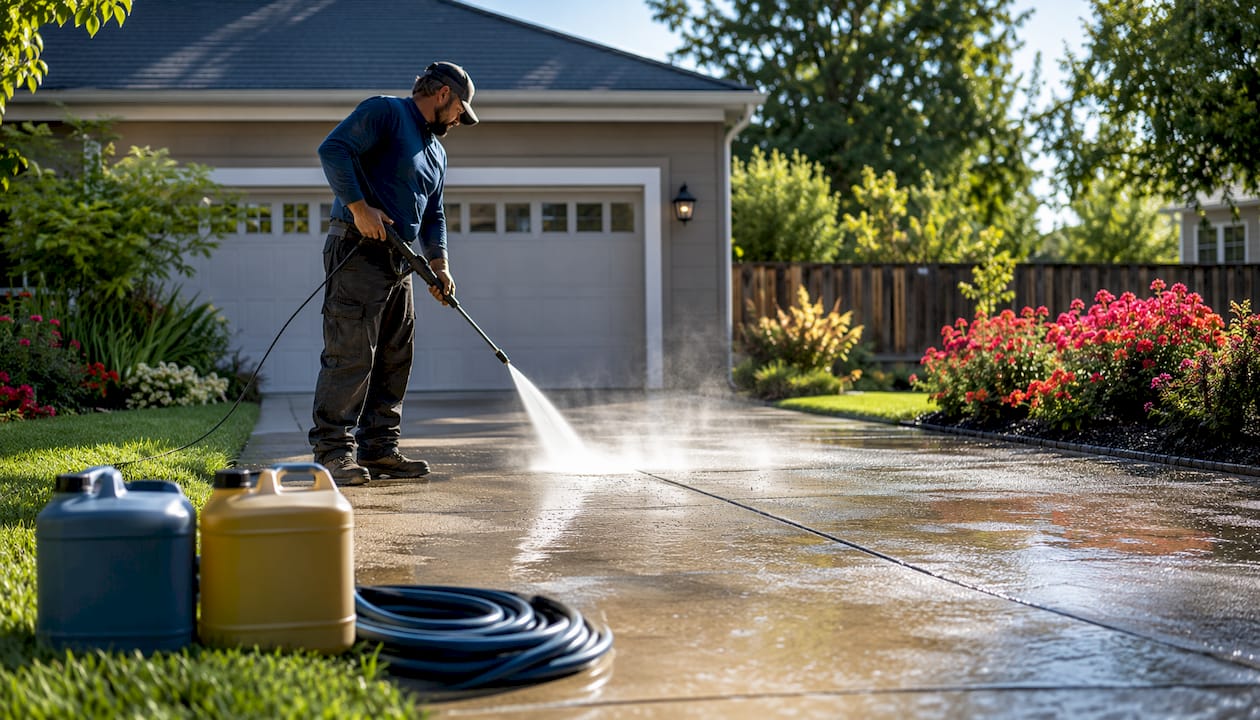
Professional sealing runs $1–$3 per square foot installed, with a typical two-car driveway (576 sq ft) costing $575–$1,700 using acrylic or polyurethane sealers. Epoxy or polyaspartic coatings push that range to $1,700–$5,200 for the same size. Labor alone accounts for $0.70–$1.25 per square foot; the rest is materials and prep.
Several factors move the final number up:
Surface condition — oil stains, prior coatings, scaling, or cracks add $0.25–$1.50 per square foot in prep costs
Sealer type — penetrating sealers run roughly $0.89–$1.04/sq ft; acrylics $1.52–$1.79/sq ft; epoxy coatings $4.00–$4.79/sq ft
Access and layout — tight-access jobs or complex shapes add 10%–25% to labor
Crack repair — sealers don’t fill cracks; repairs are priced separately
For a local driveway sealing cost comparison specific to Raleigh and Wake County, TrueSeal’s pricing guide breaks down what you’re actually paying for.
When is the best time to seal a concrete driveway in Cary?
Late spring through early fall is the ideal window for Wake County. Sealer needs ambient temperatures above 50°F and a dry forecast for at least 24–48 hours after application. Avoid sealing before rain or when overnight temps are dropping toward freezing. In Cary’s climate, April through October gives you the most reliable scheduling windows.
How often does concrete need to be resealed?
Most driveways need resealing every 2–5 years, depending on traffic, sun exposure, and the sealer type used. The simplest way to check: pour a small amount of water on the surface. If it beads up within 30 seconds, the sealer is still working. If it absorbs, it’s time to reseal.
Ready to check your driveway? If water soaks in rather than beads, request a free quote from TrueSeal and get a surface assessment before the next rain season.
Questions to ask every contractor
Are you licensed and insured? Can you show documentation on the written quote?
What prep steps are included — power washing, crack fill, degreasing?
What sealer brand and type will you use, and why is it right for my surface?
What does the warranty cover, and what voids it?
How long before I can drive on it after application?
Do you offer a maintenance package or follow-up inspection?
Red flags to watch for: no on-site visit before quoting, pressure to reseal every single year regardless of condition, and warranties with no written exclusions. Over-sealing can cause buildup, reduced traction, and adhesion problems that require corrective stripping.
A typical project runs 1–3 days: Day 1 is power washing and crack repair; Day 2 is sealer application (often just a few hours); cure time is 24–72 hours before foot traffic and up to 7 days before vehicle traffic, depending on the sealer. For detailed prep and wait times, plan your schedule before booking.
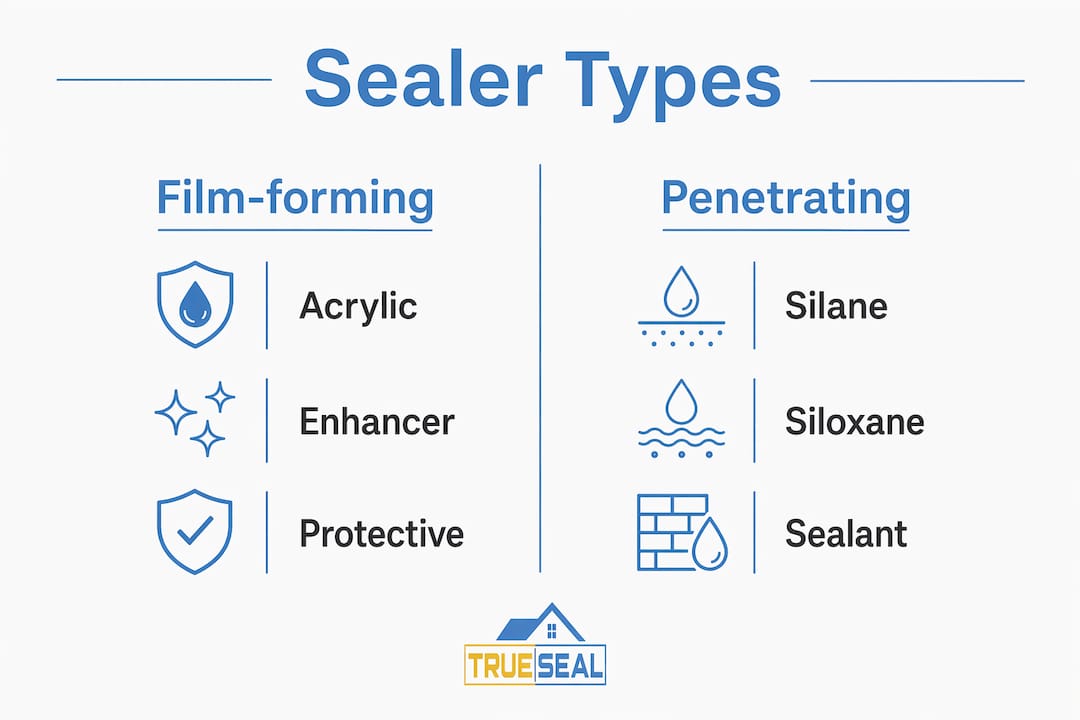
Film-forming vs. penetrating sealers: which one does your driveway need?
The short answer: choose a penetrating sealer for long-term moisture and freeze-thaw protection with a natural look; choose a film-forming acrylic when appearance and gloss are the priority, especially on decorative or stamped surfaces.
Performance comparison:
Moisture protection — Penetrating (silane/siloxane): works inside the pore structure; Film-forming (acrylic): creates a surface barrier that can wear through
UV resistance — Acrylics often include UV inhibitors for color enhancement; penetrating sealers are generally UV-neutral
Wear pattern — Acrylics show wear visibly (dulling, peeling); penetrating sealers wear gradually without visible film failure
Reapplication cadence — Penetrating: every 3–5 years; Acrylics: every 1–3 years depending on traffic
Traction — Penetrating sealers maintain natural surface texture; high-build acrylics can reduce traction if over-applied
Repairability — Penetrating sealers are easy to reapply without stripping; film-forming layers can require grinding or chemical removal if they build up unevenly
For stamped or decorative concrete, an acrylic enhancer is often the right call because it deepens color and adds sheen. For a standard gray driveway in Cary that sees daily vehicle traffic and North Carolina’s freeze-thaw cycles, a penetrating silane/siloxane sealer delivers better long-term protection with less maintenance. You can read more about stamped concrete sealing if your driveway has decorative elements.
Pro Tip: If you’re seeing white haze, peeling patches, or a slippery surface after rain, those are signs of over-sealed or incorrectly applied film-forming sealer. Penetrating sealers avoid this entirely because they don’t form a surface film that can trap moisture or peel.
Key Takeaways
Sealing your concrete driveway with the right product and proper prep is the single most effective step you can take to extend its life and protect your property value; for homeowners planning driveway-wide upgrades or integrating gates, see A Guide to Custom Driveway Gates That Last for complementary advice.
Point | Details |
Test porosity first | Pour water on the surface; if it absorbs in under 30 seconds, resealing is overdue. |
Match sealer to use case | Penetrating sealers for durability and freeze-thaw protection; acrylics for decorative gloss. |
Budget $575–$1,700 for a two-car driveway | Final cost rises with surface condition, sealer type, and crack repairs. |
Ask for written warranty and prep scope | Any quote without documented prep steps and warranty terms is incomplete. |
TrueSeal’s Clean & 7-Year Seal | TrueSeal offers a 7-year warranty with full prep and professional-grade sealer for Cary and Wake County homeowners. |
Why preparation determines whether your sealer lasts or fails
Most sealer failures come back to one thing: the surface wasn’t ready. Concrete acts like a hard sponge — it absorbs whatever you put on it, including contaminants that block sealer penetration. When a contractor skips thorough power washing, degreasing, or crack repair, the sealer bonds to dirt and oils instead of the concrete itself. The result is peeling, patchy coverage, and a warranty claim that goes nowhere.
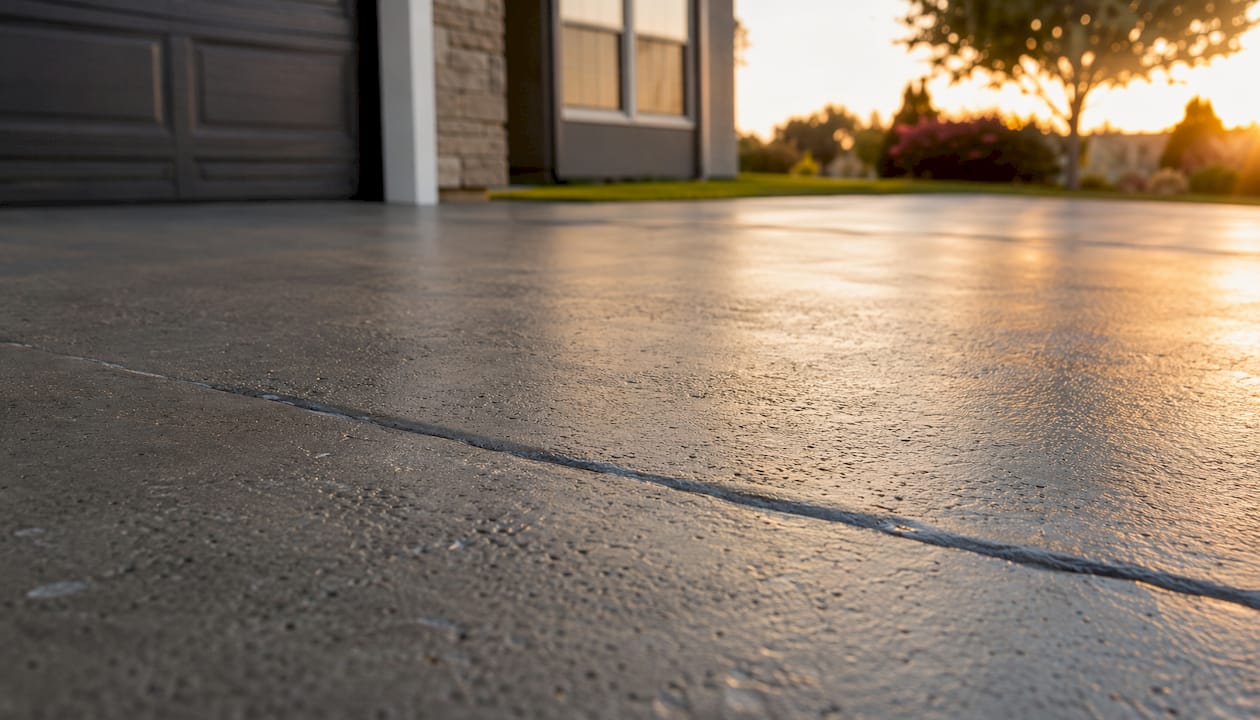
At TrueSeal, we see this pattern regularly. A homeowner had a driveway sealed two years ago, but the prep was a quick rinse and a fast roll. The sealer is already failing at the edges and around the expansion joints, exactly where moisture gets in first. Proper prep takes longer and costs a bit more upfront, but it’s the only reason a 7-year warranty is possible. Vague warranties with no written exclusions are usually a sign that the contractor knows the prep was insufficient. Ask specifically what voids the warranty before you sign anything.
Schedule your concrete sealing service with TrueSeal
[
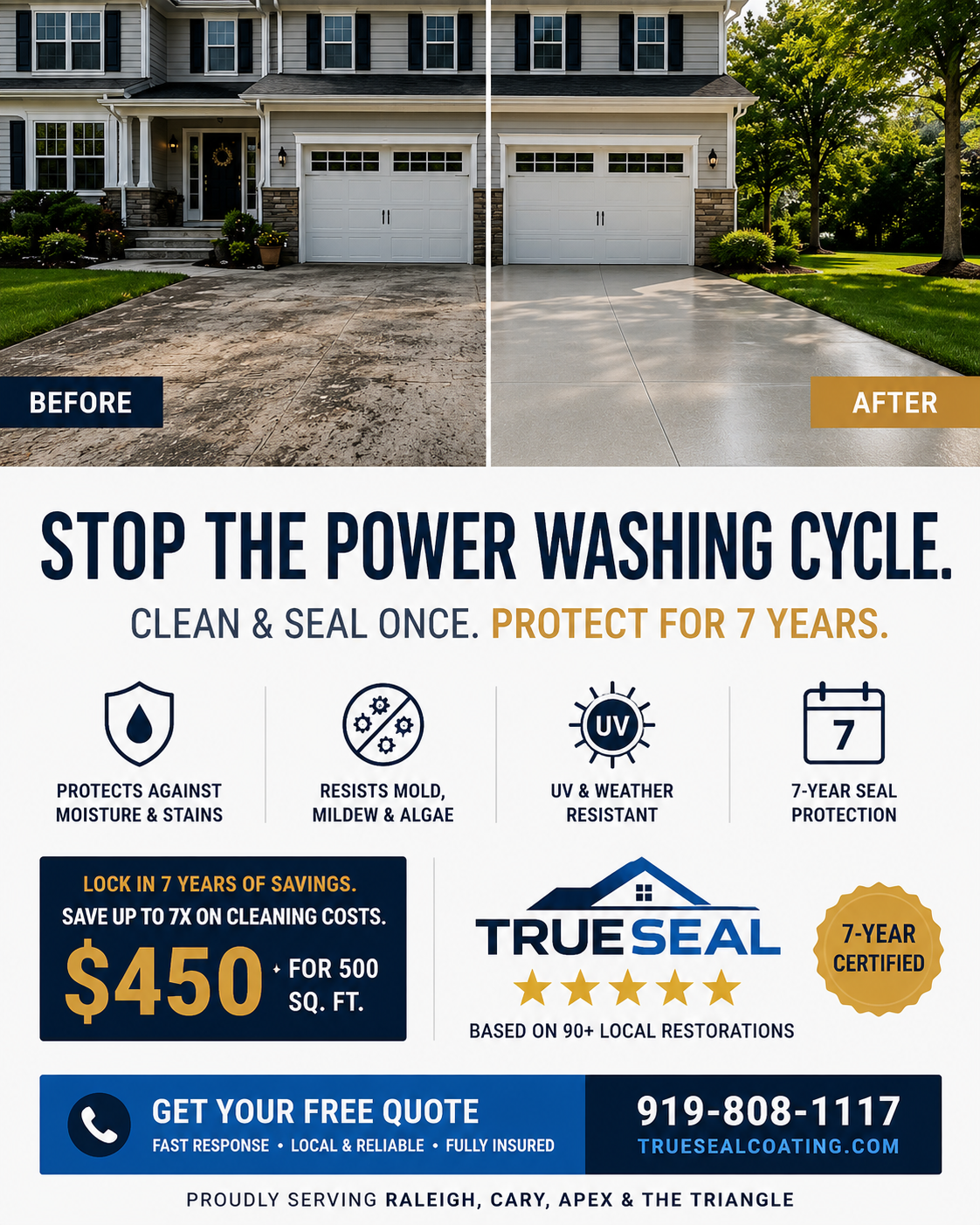
TrueSeal’s Clean & 7-Year Seal is built for North Carolina’s climate: hot summers, freeze-thaw cycles, and the kind of humidity that accelerates surface wear. The service includes a full power wash, crack fill where applicable, a professional porosity assessment, and application of a commercial-grade penetrating or film-forming sealer matched to your specific surface. The 7-year warranty is written, not verbal, and covers the application against premature failure under normal use.
If your driveway, patio, walkway, or pavers no longer bead water, it’s time for professional protection. Property managers handling multiple surfaces across Wake County can also explore TrueSeal’s commercial surface protection services, which cover parking lots, HOA pavement, and multifamily communities.
Schedule Your Concrete Sealing Service. Request Your Free Quote Today.
FAQ
Is it worth sealing a concrete driveway?
Yes. Sealing blocks moisture, oil, and deicing salts from penetrating the slab, which reduces freeze-thaw spalling and surface wear. It also preserves color and finish, extending the driveway’s useful life.
What is the average cost to seal a concrete driveway?
Professional sealing costs $1–$3 per square foot, with a standard two-car driveway running $575–$1,700 for acrylic or polyurethane sealers. Epoxy or polyaspartic coatings cost more.
What is the best time of year to apply driveway sealer?
Late spring through early fall works best. Temperatures should stay above 50°F and the forecast should be dry for at least 24–48 hours after application. In Cary, April through October is the most reliable window.
How often does a concrete driveway need to be resealed?
Every 2–5 years, depending on traffic and sealer type. Use the water-drop test: if water absorbs into the surface within 30 seconds rather than beading, it’s time to reseal. TrueSeal’s Clean & 7-Year Seal extends that interval significantly with a professional-grade application.
Recommended


Comments